
You may have asked yourself:
– How did my cost of living get so high?
– Why don’t my dollars buy as much as they used to?
The answer rests in two terms you’ve likely heard before:
– Quantitative Easing
– (which contributes to / leads to) Inflation
These two terms could also be described as:
– The debasement of your currency
A picture tells one thousand words, so before we explore these terms in greater detail, let’s examine some images showing how currency debasement works.
Currency debasement in the Ancient World
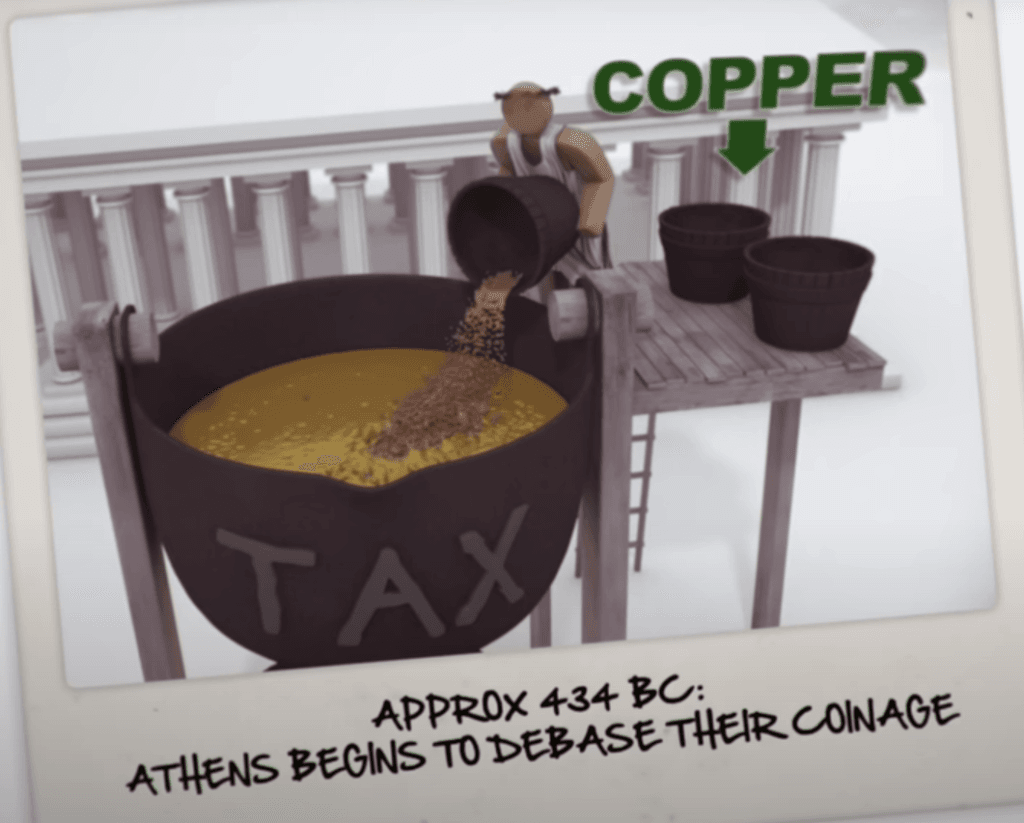
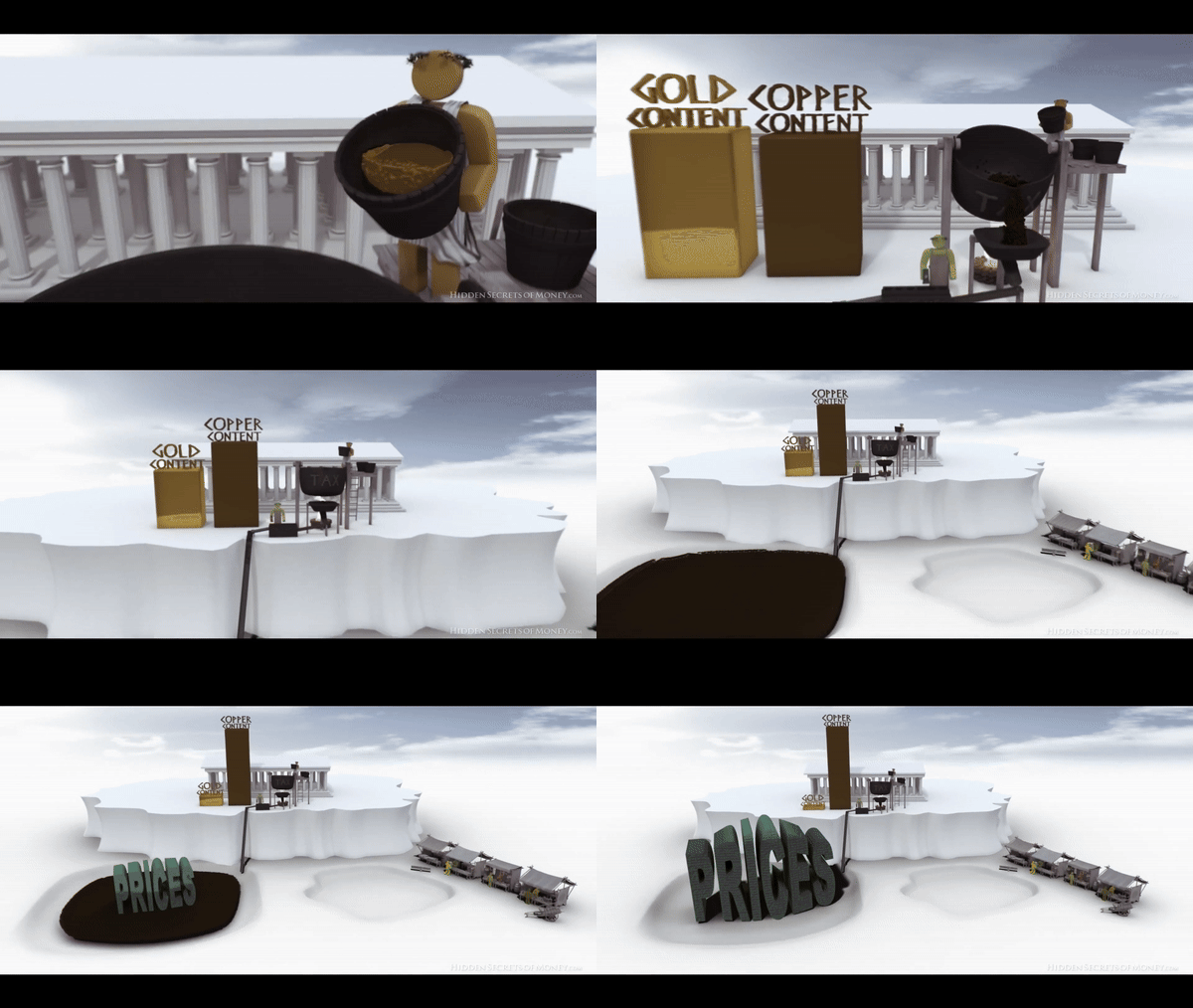
Athens was once known for its high purity silver coinage.
During the Peloponnesian War against Sparta, Athens began minting plated coins (mostly base metals with a thin silver plating) and bronze coins.
As the precious metal content in Athenian coins dropped, the value of those coins plummeted, and thus the number of coins required to purchase goods (i.e. the price of the goods) rose sharply.
Image source: Mike Maloney’s Hidden Secrets of Money – Episode 2
Other sources: https://numismatics.org/the-matter-of-inflation/
The Roman Empire is also known to have debased its gold and silver coinage with base metals such as copper, something it did time and time again over centuries.
Currency debasement in the Middle Ages
Fast forward a millennia to England in the middle ages.
Debasement had been common and quite severe throughout much of medieval Europe, especially in France, but it had been essentially nonexistent in England from the thirteenth to the sixteenth century. For approximately 400 years, England had maintained 92.5 percent purity for sterling.
Between 1544 and 1551 Henry VIII and Edward VI systematically debased the currency—replaced precious metal content of coins with base metals. With Henry’s debasement, the purity of coins gradually dropped to 75 percent, then to 50 percent, to 33 percent, and finally to 25 percent. As a result, the earlier prestige of English coin, which at times had been the envy of northern Europe, quickly disintegrated over a brief period.
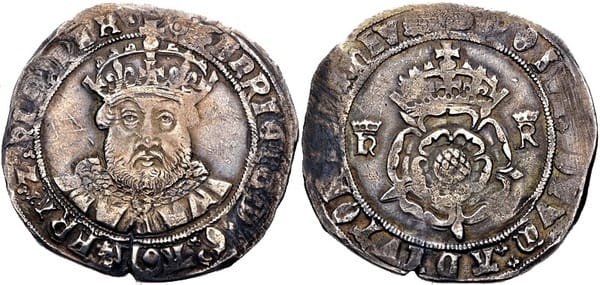
The thin layer of silver on Henry’s debased testoons had a tendency to wear off, particularly over the protruding nose of his portrait, revealing the copper colour underneath – earning Henry the nickname of ‘Old Coppernose’.
Image source: 1 Testoon – Henry VIII 3rd coinage
Other sources: ‘Old Coppernose’: Henry VIII and the Great Debasement
The Great Debasement and Its Aftermath
Currency debasement in the Modern World

Where does a Central Banker like to hang out?
In de basement.
That much is clear from the Money Printer Go Brrr meme above.
If you’re wondering what the red text going in to the money printer says, it says “INFLATION” and that’s exactly what results from increasing the supply of currency. Remember that as the currency supply increases, so does the price of goods and services, because the value of each currency unit (E.G. $) is falling.
Our modern coinage supply has been near worthless for some decades now. Here are some of the latest developments:
- U.S. Cent – prior to 1982 was composed of 95% copper, 5% nickel; whereas since 1982 it is composed of 97.5% zinc (much cheaper than copper) 2.5% copper (plated).
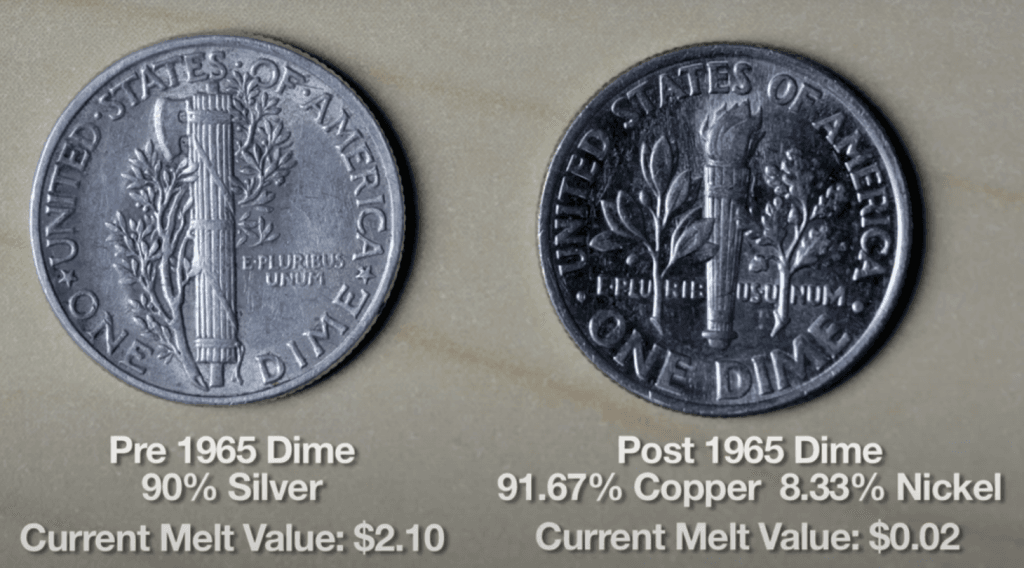
- U.S. Dime – prior to 1965 was composed of 90% silver, 10% copper; whereas since 1965 it is composed of 91.67% copper and 8.33% nickel in the form of a pure copper core surrounded by a cupronickel plating of 75% copper 25% nickel.
- U.S. Dollar – changed from 90% silver, 10% copper to cupronickel in 1965, then to the Sacagawea dollar composed of copper and zinc in 2000, now since 2011 dollar coins are no longer minted for circulation and only paper debt instruments (dollar bills / notes) are used for general circulation.
If you live outside the U.S. you will also find that your local coinage has used increasingly cheaper metals and become less prevalent as paper, plastic and electronic transactions have taken over.
Let’s return to our original question. You asked yourself:
– How did my cost of living get so high?
– Why don’t my dollars buy as much as they used to?
Revisit the animations above and you will see the process of how this happened was as follows:
PHASE 1: The coinage began as rare precious metals. A man’s labour went into locating and extracting the rare metal from the earth, refining it and stamping it into a coin of standardised weight and composition. When you hold a precious metal coin, you hold something of tangible value due to its rarity and the labour that went into creating the coin. During this phase, the currency can be considered as money because the coin is a store of value and nobody else has a claim on a coin that you hold in your hand.
PHASE 2: The coinage was diluted with base metals until very little further dilution was possible. The base metals are less rare and they tarnish more readily than precious metals, making them less of a store of value than the coinage from the previous phase. As the coinage is diluted the price of goods increases. The Athenian animation and the pre-1965 and post-1965 dime are examples of this phase.
PHASE 3: The coinage was gradually, but continually replaced with debt instruments / IOUs, starting with gold certificates (redeemable in gold coin payable to the bearer on demand), then paper bills / notes no longer tied to gold, followed by credit cards and eventually electronic settlement of debts. During this phase, the currency no longer holds any tangible value – very little labour went into printing the certificates, bills or notes and those notes are not at all rare. The currency can no longer be considered money and is now in fact an IOU – a claim check on coinage from the first phase. As the IOUs lose their tie to precious metals, the price of goods increases.
PHASE 4: The paper and electronic IOUs are proliferated. More IOUs are created than the amount of tangible precious metal wealth available for settlement of the debts. As the number of IOUs (currency supply) explodes higher, the price of goods increases at an ever faster rate.
Solutions
Let’s conclude by talking about solutions to this problem.
In other words:
– How would Riley of Wrongthink.org protect himself from currency debasement and the increasing price of goods and services?
Solution 1: Riley would never store his wealth in his local currency, unless his local currency is a precious metal of high purity like in PHASE 1. Riley would store his wealth in something tangible & rare – precious metals and productive land.
Solution 2: Riley would measure his wage/income against the expansion of the currency supply. A 3% pay rise when inflation of the currency supply is running at 8% is technically a 5% reduction in one’s real purchasing power. One may find that their wage has decreased over time when measured in ounces of gold. To keep one’s purchasing power intact one may need to negotiate a better raise, or find new employment, or work on generating more cash flow from a business or side hustle.